By: Melvin Flomo
WhatsApp: 0778677647
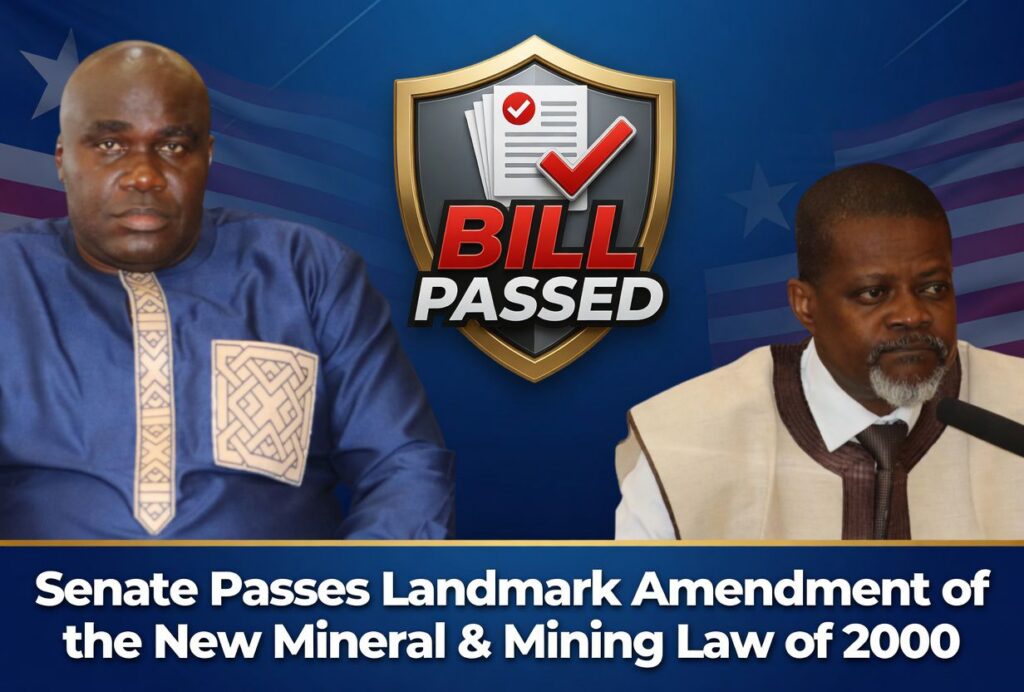
MONROVIA, Liberia – In a major legislative move aimed at increasing Liberian participation in the country's extractive sector, the Liberian Senate has passed a landmark amendment to the New Mineral and Mining Law of 2000, reserving Class B Mining Licenses exclusively for Natural Born Liberians.
The amendment, approved during Tuesday's plenary session, seeks to strengthen local ownership within the mining industry while preventing foreign control of licenses designated for Liberian entrepreneurs. Under the new provisions, holders of Class B licenses will face legal sanctions if they sell, assign, transfer, or otherwise relinquish ownership interests to non-Liberians.
The legislation amends Part I, Chapter 2, Section 2, Sub-section 4.2(f) of the existing law and introduces new provisions under Chapter 6, Section 16.2 and Chapter 22, Section 22.1 of Title 23 of the Liberian Code of Laws Revised.
The Senate's decision followed recommendations from a Joint Committee comprising the Committees on Lands, Mines and Energy, and Judiciary, Human Rights, Claims and Petitions. In its report, the committee emphasized that the amendment is intended to foster the growth of a stronger Liberian middle class and stimulate economic expansion through greater local participation in mining activities.
Presenting the committee's findings to plenary, Grand Cape Mount County Senator and Committee Chairman Simeon B. Taylor argued that the legislation represents a significant step toward economic empowerment for Liberian citizens.
According to Senator Taylor, the amendment will create opportunities for more Liberian-owned businesses, strengthen domestic investment in the mining sector, and provide citizens with greater leverage over the nation's natural resources.
"This amendment will create more Liberian-owned businesses, boost the Liberian economy, and ensure Liberians get leverage in the mining industry by taking charge of the Class B and C Mining Licenses," Taylor told fellow lawmakers.
He further described the measure as part of the Senate's broader legislative reform agenda aimed at ensuring that natural resource policies generate tangible economic benefits for Liberians.
Class B Mining Licenses are designated for semi-mechanized mining operations and currently require a licensing fee of US$15,000 for gold and diamond mining activities under regulations established by the Ministry of Mines and Energy. The licenses occupy a middle tier within Liberia's mining framework, positioned between large-scale industrial Class A licenses and artisanal Class C licenses.
Supporters of the amendment argue that reserving these licenses for Liberians could help increase local ownership in a sector historically dominated by foreign investment and operators. They contend that the policy could create jobs, encourage indigenous entrepreneurship, and enable more Liberians to directly benefit from the country's mineral wealth.
The amended legislation will now be transmitted to the House of Representatives for consideration. Should the lower chamber concur with the Senate's action, the bill will be forwarded to President Joseph Boakai for approval and eventual enactment into law.
The measure forms part of a wider package of mining-sector reforms currently being pursued by lawmakers, including the Gold Sector Reform Amendment Act of 2026, which seeks to formalize artisanal mining activities and establish mandatory local gold refining mechanisms.
The bill was sponsored by Simeon B. Taylor and co-sponsored by Abraham Darius Dillon.
The legislation could mark a significant shift in Liberia's natural resource governance framework, placing greater emphasis on local participation and economic empowerment within the mining sector while setting new standards for ownership and control of mineral development opportunities.
About the Author