By: Melvin Flomo
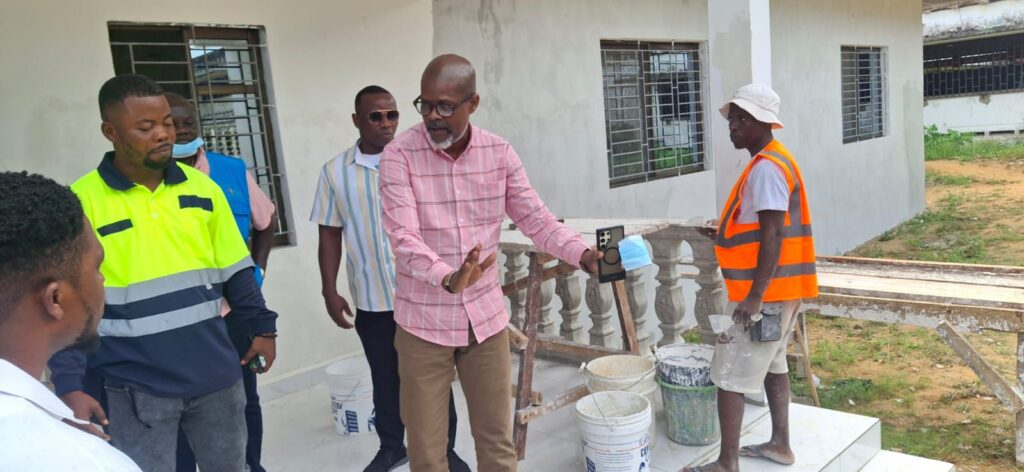
Montserrado County Senator Abraham Darius Dillon has reaffirmed his commitment to expanding educational opportunities in Liberia following an inspection tour of a modern public library currently under construction in Sinkor.
The facility, strategically located near William V. S. Tubman High School on Sweltering Street, is being developed as a state-of-the-art public learning center designed to enhance literacy, research capacity, and digital access for students and the broader population.
During the tour, Senator Dillon provided a detailed breakdown of the project’s financing, emphasizing transparency and accountability in the use of public funds. According to him, the initiative is being funded through his legislative budgetary allocation, with an initial investment of approximately US$67,000 covering core construction and contractor costs.
However, the project underwent significant upgrades after portions of the initial work failed to meet required standards. Dillon disclosed that an additional US$20,000 was injected to reconstruct and improve sections of the building, ensuring durability and quality. With ongoing finishing works—including electrical installations, fittings, and interior enhancements—the total cost has now exceeded US$90,000.
“We are not just building a structure; we are building a modern facility that will stand the test of time,” Dillon stated. “Every dollar spent here is for the benefit of the Liberian people.”
He clarified that the project is a completely new construction rather than a renovation, setting it apart from many existing public facilities. Once completed, the library will include reading halls, dedicated research spaces, and digital learning infrastructure aimed at meeting contemporary academic demands.
In line with global trends in education, plans are underway to equip the facility with high-speed internet—potentially through satellite connectivity—allowing users to access international research databases and digital resources. The library will also host a growing collection of books and academic materials to support both formal and informal learning.
“Reading makes a ready man, but research makes a complete man,” Dillon remarked, underscoring the importance of blending traditional reading culture with modern research tools.
In a significant policy declaration, the Senator assured that the library will operate as a free public facility, accessible to all Liberians without any usage fees.
“No one will pay to use this library. It is not for private profit—it is for the public good,” he emphasized.
Upon completion, the facility will be handed over to the Ministry of Education for management. However, Dillon indicated that his office will maintain oversight to ensure operational standards are upheld. He further stressed that the management team will be selected strictly based on competence and professionalism.
“This will not be about sympathy or connections. It will be about capacity and readiness to deliver,” he added.
Liberia continues to grapple with a shortage of functional public libraries, a challenge that has long hindered access to academic resources for students and researchers. Dillon noted that many young Liberians have been forced to rely on inadequate study environments due to the absence of well-equipped public learning spaces.
“This project is a response to a real need. Many of our young people have never had access to a proper public library,” he said.
The project is expected to be completed within the next two months, after which it will be officially opened to the public. While there have been growing calls for similar initiatives across other districts, Dillon emphasized a phased approach to development.
“You cannot do everything at once. You start, you succeed, and then you expand,” he concluded.
Once operational, the library is expected to serve as a hub for academic excellence, innovation, and community engagement—potentially setting a new benchmark for public educational infrastructure in Liberia.
About the Author